
Makinde Unveils Four-Pillar ‘Reset Agenda’, Says Nigeria Needs Systemic Change
Oyo State Governor, Seyi Makinde, has unveiled a four-pillar agenda for what he described as the “Reset Nigeria” project, saying the country requires systemic changes to improve the lives of its citizens.
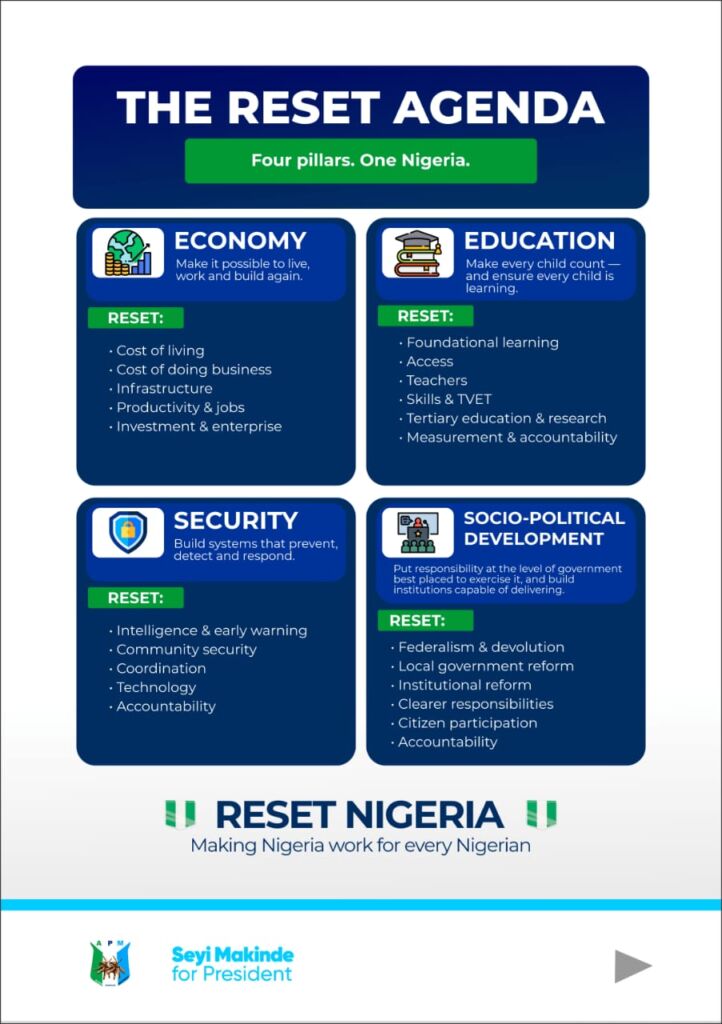
Makinde, who outlined the agenda in a statement, on newsletter on his social media handles, said the proposed framework focuses on four key areas: Economy, Education, Security and Socio-Political Development.
The governor said the agenda was designed to address what must change for Nigerians to have a fair opportunity to build better lives, stressing that the Reset Nigeria project was not about blind followership or entitlement.
According to him, the economic component of the agenda will focus on reducing structural costs that make living and doing business expensive, improving infrastructure, supporting productive sectors and creating a more predictable environment for businesses to thrive.
Makinde said his administration had applied similar thinking in Oyo State through investments in infrastructure, agribusiness and the development of secondary cities, adding that the objective was to ensure that economic growth translated into better opportunities and improved living conditions.
On education, the governor said Nigeria must improve its ability to determine how many children are out of school, how many remain in education and whether pupils are actually acquiring the required knowledge and skills.
He said the Reset Agenda would cover foundational learning, access to education, teacher quality, curriculum, technical and vocational education, tertiary education, research, funding, measurement and accountability.
Makinde acknowledged that despite investments in education in Oyo State, the state still has children who are out of school, noting that enrolment and attendance alone were insufficient without measuring actual learning outcomes.
On security, the governor described it as one of the fundamental responsibilities of government, saying Nigerians should be able to travel, farm, trade, attend schools and worship without constantly fearing for their safety.
He cited Nigeria’s movement from eighth to fourth position on the Global Terrorism Index between 2023 and 2025 as an indication of the worsening terrorism situation, while stressing the need for intelligence, early warning, prevention and effective coordination among security agencies and communities.
Makinde also highlighted Oyo State’s security architecture, including the 615 emergency line, Security Control Room and City Watch facilities, as mechanisms designed to improve information gathering, monitoring and response.
On the socio-political pillar, the governor called for a review of Nigeria’s federal structure, asking whether the current system gives states and other levels of government sufficient powers and institutional capacity to effectively address issues within their jurisdictions.
He said the issue of local government autonomy should not be discussed solely from the perspective of financial independence, arguing that questions surrounding the creation, responsibilities and relationship between local governments and states must also be examined.
Makinde stressed that transferring powers without strengthening institutions would not solve Nigeria’s problems, saying responsibilities must be clearly defined and every level of government must have the capacity to deliver and remain accountable.
The governor said the four pillars of the Reset Agenda were interconnected, noting that insecurity could undermine farming and investment, while poor education could limit economic productivity and weak institutions could prevent sound policies from producing lasting results.
He said further details of the agenda would be unveiled in the coming weeks, including the evidence behind the proposed reforms, specific interventions, methods of measuring outcomes and lessons from his administration’s experience in Oyo State.
Makinde said the ultimate objective was for the Reset Nigeria project to go beyond a political slogan and provide clear answers to Nigerians on what would change and how such changes would improve their lives.