
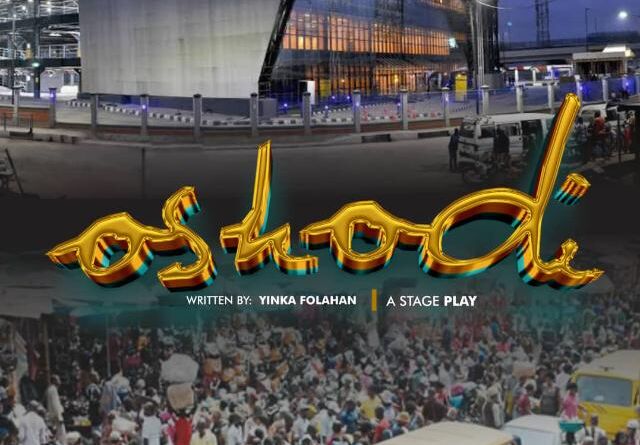
Yinka Folahan’s Oshodi Goes to Theatre in Lagos
Lagos Theatre Presents Yinka Folahan’s Twisted Tale of Ambition, Power and Betrayal
The stage adaptation of Yinka Folahan’s Oshodi : “A Place of Movement”, directed by Mr. Timileyin Ayeno and performed at the New Theatre Hall, Lagos State University of Education, Ijaniki, Lagos, on June 3, 2026, has firmly established the names of everyone involved—from the playwright to the director and cast members—as exceptional contributors to contemporary Nigerian theatre.
Presenting a historical narrative through the medium of theatre rather than film is a demanding artistic undertaking. Unlike film, where editing can correct mistakes and enhance storytelling, theatre requires performers to sustain energy, coherence, and emotional intensity throughout a live performance. The cast of Oshodi rose impressively to this challenge, delivering a performance that was both compelling and memorable.
Having read the text and witnessed the stage production, it is evident that Yinka Folahan carefully distinguishes between myth and history while exploring the interconnected themes of power, trust, jealousy, betrayal, and sacrifice. Through the story, the playwright examines how ambition and false accusations can alter the course of individual lives and entire communities.
The significance of this production cannot be overstated. As the first major public performance of the stage play titled “Oshodi: A Place of Movement” (produced by the Lagos State Council for Arts and Culture) was staged at the Alliance Française, Mike Adenuga Centre in Ikoyi, Lagos and the second performance; also on Lagos soil, featuring a cast largely made up of Lagos residents, it provided an opportunity for Lagosians to engage directly with a story rooted in their historical and cultural heritage. The performers demonstrated a remarkable understanding of the narrative, resulting in a production of exceptional quality.
At its core, Oshodi is a historical drama that revisits the history of Eko (Lagos) in the seventeenth century. The play tells the story of Oshodi, a prince from Bida whose wisdom and leadership contribute significantly to the development of transportation and commerce in Eko. However, his achievements attract envy among certain chiefs, who falsely accuse him of engaging in an affair with Mopelola, the king’s wife.
Convinced by these allegations, the king turns against Oshodi. Unable to endure the shame and humiliation brought upon her, Mopelola takes her own life. Before her death, she offers prayers on Oshodi’s behalf. Through this tragic sequence of events, the play explores enduring themes such as sacrifice, jealousy, betrayal, honour, and the devastating consequences of false accusations.
Speaking on the production, director Timileyin Ayeno said, “My vision for Oshodi is to present a production that not only reflects the historical story of Eko in the seventeenth century but also speaks to contemporary society through its themes of jealousy, betrayal, sacrifice and false accusations. The production adopts elements of realism, Brechtian Epic Theatre and African Total Theatre through the use of narration, symbolism, music, dance and stylized performance to create both entertainment and critical reflection.
Through these techniques, the audience is encouraged to connect with the story while also reflecting on the moral and social consequences of the characters’ actions.”
One of the most remarkable achievements of the production lies in its ability to serve as a critical interpretation of the text. Theatre remains one of the most effective forms of literary criticism because it transforms written words into living experiences. The cast maintained a high level of linguistic proficiency, effectively conveying the playwright’s simple yet powerful language and emotional depth.
Furthermore, the production successfully balanced entertainment with intellectual engagement. While Folahan’s text appears to foreground feminist concerns through the tragic fate of Mopelola and the consequences of patriarchal power structures, Ayeno’s direction places significant emphasis on Oshodi’s heroic contributions and the historical foundations of the community that bears his name today.
Ultimately, the production of Oshodi stands as a testament to the vitality of Nigerian theatre and the enduring relevance of historical drama. Through strong performances, creative direction, and thoughtful storytelling, the play not only preserves an important aspect of Lagos history but also invites contemporary audiences to reflect on timeless issues of power, justice, trust, and betrayal.
It is equally important to note that in establishing the storyline as a true history and representation of the people’s story, the author notes that, ” the story is credited to the creative imagination of my Mother’s memory, of which I’m indebted to present as real as possible. And the memory is the personal, subjective, and emotional recollection of an event kept alive by individuals and communities. History is the critical, evidence-based reconstruction of the past, aiming for objective truth by analyzing archives, artifacts, and multiple (often conflicting) perspectives. and for the production, he notes that, “I never expected the genius presentation of the play, and one hour production remains vivid in my imagination. I must salute the hard work, dedication employed in the preparation, rehearsal and production of the stageplay. It is history of a kind”.
Deliberately mentioning the names of of the characters and casts for this production, Oshodi Cast list, for the sake of posterity: Adekoya Feranmi – Oshodi /Orchestre; Kadiku Muiz – Eshinlokun; Ibrahim Tobi – 1st chief ; Tonueyi Taiwo – 3rd Chief; Anjorin Naomi – Queen/Ochestra; Akindubuwa Oreoluwa – Spirit
; Akamo Olajide – Guard ; Flexi – Extra ; Akala olamide -Orchestra Villager
Benson Alexandra – Mopelola
jayi ; osep – warrior
Agidigada Aminat – Herb seller/villagers; Lateef Aishat – Spirit/villager
Rauf Bushiroh – Slave,passenger and Spirit.; Godonu Rebecca – Orchestra
Okologume Prosper – Choreographer/Dancer; Boluwatife Oladipupo – messenger; Adekoya Adedamola – Warrior; Ayoola Islamiyat – Spirit; Akala olamide- Orchestra / Villager
Okologume Prosper – Choreographer/Dancer; Adebayo Adedeji – Driver ; Nzekwue chiamaka – Messenger /Spirt; Ashiyanbi Deboral – Ilusional spirit; Fagbamila Omoniyi – Warrior; Olademeji Stephen – Drummer; Bitrus Patience Joy – Dancer; Abu Mistura – villager; Ajulo Damilare -Dancer; Motadegbe Oluwaseyi – Conductor; Wura – Lead Orchestra i; Albert Islamiyat Eniola- Crowd
member ,Spirit , Villager; Agba Goodluck – Olori; Florence Kalu – Dancer; Kpade Michelle – Illusion spirit;Öri Ade – Drummer; Kehinde Thompson – Technical
Obioha Victor – Technical; Oluwaseun Modupe -Olori; Bitrus Patience Joy – dancer; Adeyemo Adeola – villager; Ghazad Shinikun – 2nd chief ;Adeyemo Adeola – Villager; Nwachukwu Chisom – Passenger ,Spirit;Babatunde Mary – choreographer/demon/dancer; Ogechi – Dancer; Bada Temiloluwa Damilola – witch and orchestra; Olatoye Suwebat – Orchestra and Chanter.