Seyi Makinde: The Father Figure of Nigeria’s Opposition Poised to Lead a Rainbow Coalition in 2027 – By Laja Adeoye
As Nigeria hurtles toward the 2027 general elections, one question burns on the lips of every politically conscious citizen: Is the Independent National Electoral Commission (INEC), under Professor Joash Ojo Amupitan, SAN, taking sides in the festering PDP leadership crisis?
The Peoples Democratic Party (PDP), once the dominant force in Nigerian politics, now finds itself in a constitutional and legal quagmire that threatens to consign it to the dustbin of history due to machinations of those who have sworn to work for the re election of President Bola Tinubu, while still parading themselves as members of the PDP. At the heart of the storm is whether INEC is shielding a faction whose very existence the party’s constitution does not recognise: the so-called Wike-backed Caretaker Committee.
Let us recount the facts with surgical precision.The Supreme Court, in a landmark ruling, nullified the PDP’s controversial National Convention held in Ibadan on November 15 and 16, 2025. The apex court declared the gathering illegal because it flagrantly disobeyed a subsisting Federal High Court order. For clarity, an Ibadan High Court had earlier granted permission for the convention to proceed following a suit filed by party stalwart Malomo from Lagos State, who feared his right to contest national office would be stifled. That permission, however, according to the apex court could not override the Abuja High Court’s earlier restraining order.
In the same breath, the Supreme Court upheld the Abuja High Court’s decision to sack Senator Samuel Anyanwu and dismissed the cross-appeal filed by Kamaldeen Ajibade, SAN. Their suspension by the then Damagum-led PDP leadership was affirmed. Yet, rather than serve out their suspension and seek clearance, they defied the party. In brazen disregard of the law, they proceeded to appoint Abdulrahman Mohammed as National Chairman via a letter signed by the now suspended Anyanwu, who no longer possessed any legal authority to speak for or act on behalf of the PDP.
The Supreme Court has now handed the party back to its rightful owners. A two-thirds majority of the National Executive Committee (NEC), midwived by the Chairman and Secretary of the Board of Trustees, Senator Adolphus Wabara PhD, and Babangida Aliyu, swiftly appointed an Interim National Working Committee to fill the vacuum. Yet INEC, under Professor Amupitan, has curiously refused to expunge the names of Anyanwu and his allies from its official records, despite formal communication from the new interim leadership. Contrast this with the alacrity INEC displayed barely 24 hours after the Supreme Court’s ruling on the African Democratic Congress (ADC), the commission promptly updated the leadership details of the David Mark faction. The double standard is glaring. Why the selective speed? Nigerians are watching, and questions of impartiality refuse to fade.
The Man Who Refused to Budge
While other PDP governors jumped ship to the ruling All Progressives Congress (APC) in search of political survival, one man stood firm like the rock of Gibraltar, Governor Seyi Makinde of Oyo State.
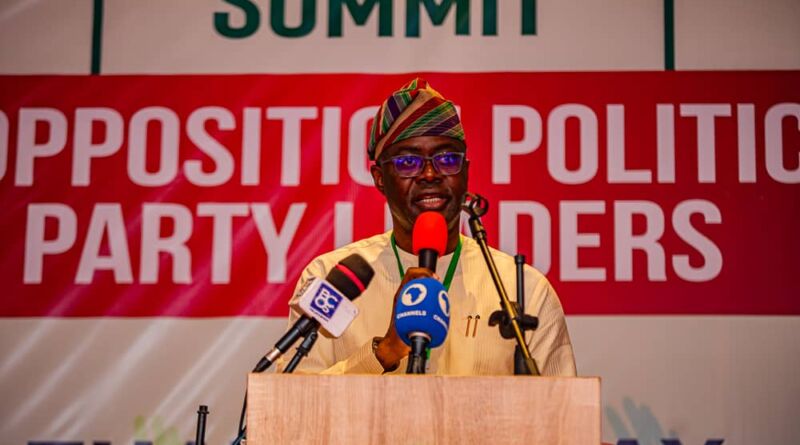
Makinde has emerged as the undisputed father figure of the Nigerian opposition, despite daily media attacks from Wike and his group, Seyi Makinde, a steady hand in turbulent waters, a strategist who sees beyond the immediate horizon. When the APC’s political machinery attempted to swallow the opposition whole plotting with internal saboteurs , Makinde refused to flinch. Instead, he convened the historic National Summit of Opposition Political Parties in Ibadan on April 25, 2026. The gathering, attended by heavyweights including Atiku Abubakar, Rotimi Amaechi, Peter Obi, Ogbeni Rauf Aregbesola, Taminu Turaki, Rabiu Kwankwaso, Prof Jerry Gana, Chief Bode George (Represented) and other heavy weight politicians across the broad spectrum, was more than a talk shop. It was a clarion call for unity ahead of 2027.
That bold move, however, unsettled some power brokers. Critics point to Peter Obi and Kwankwaso’s subsequent departure from the ADC to the newly formed National Democratic Congress (NDC) as evidence of discomfort with any platform that insists on democratic primaries. Detractors have labelled Obi an “unstable character” unwilling to subject himself to the rigours of internal party democracy. Whether fair or not, the perception persists that some opposition figures prefer personal ambition over institutional discipline.
A Tactical Rainbow Coalition Takes Shape
As the 2027 election clock ticks louder, the battle for the soul of the PDP rages on in court. With the party yet to announce a clear platform to meet INEC’s registration deadlines, and with the electoral umpire showing no willingness to extend timelines, pragmatism demands new thinking.
Enter the Rainbow Coalition, a tactical alliance of like-minded opposition forces anchored by the authentic, mainstream PDP structure. Governor Seyi Makinde is widely expected to provide the leadership glue that holds this diverse spectrum together. The recent defection of Bauchi State Governor Bala Mohammed to the Allied Peoples Movement (APM) only underscores the shifting sands. Mohammed has already declared his senatorial ambition under the new platform, and analysts predict his successor in Bauchi will likely follow suit.
PDP insiders insist the party will eventually speak with one voice on its electoral vehicle, but events are moving at breakneck speed. In the coming days, swift realignments, fresh declarations, and strategic mergers are inevitable.
Seyi Makinde has proven he is not just a survivor, he is a unifier, a bridge-builder, and a visionary who understands that Nigeria’s salvation lies not in one man or one party, but in a formidable, principled coalition capable of challenging the APC’s dominance.
The father figure of the opposition is ready. The rainbow is forming. And 2027 may yet belong to those bold enough to stand together when others chose to scatter. The only question left is: will INEC play fair, or will it become another obstacle on the road to democratic renewal? Nigerians are waiting for answers.