
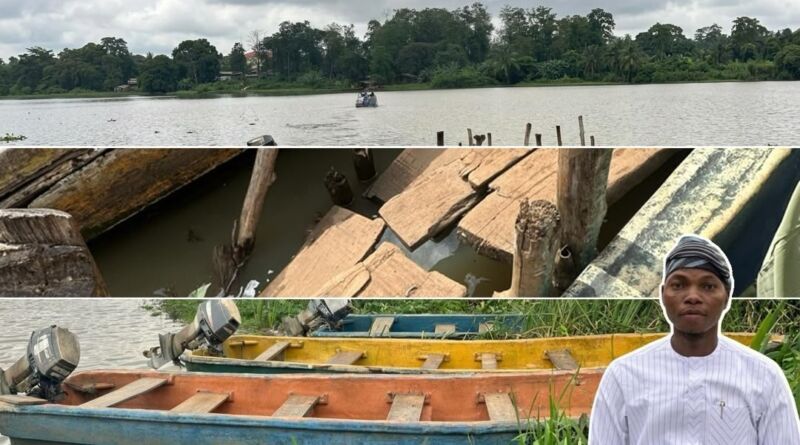
₦100 Across the River: The Untold Story of Apete Residents’ Dependence on Eleyele Boat Services | Kehinde Ayanboade
At about 7:30 p.m., the boat conveying passengers across the Eleyele River suddenly developed an engine fault midway through the journey.
For a few tense seconds, the only sound was water lapping against the plastic hull.
The wind began to rise, passengers shifted uneasily on their wooden seats, and the opposite bank, though visible, suddenly seemed farther away.
The boat operator remained calm.
He reassured the passengers and made several attempts to restart the engine, but it refused to respond.
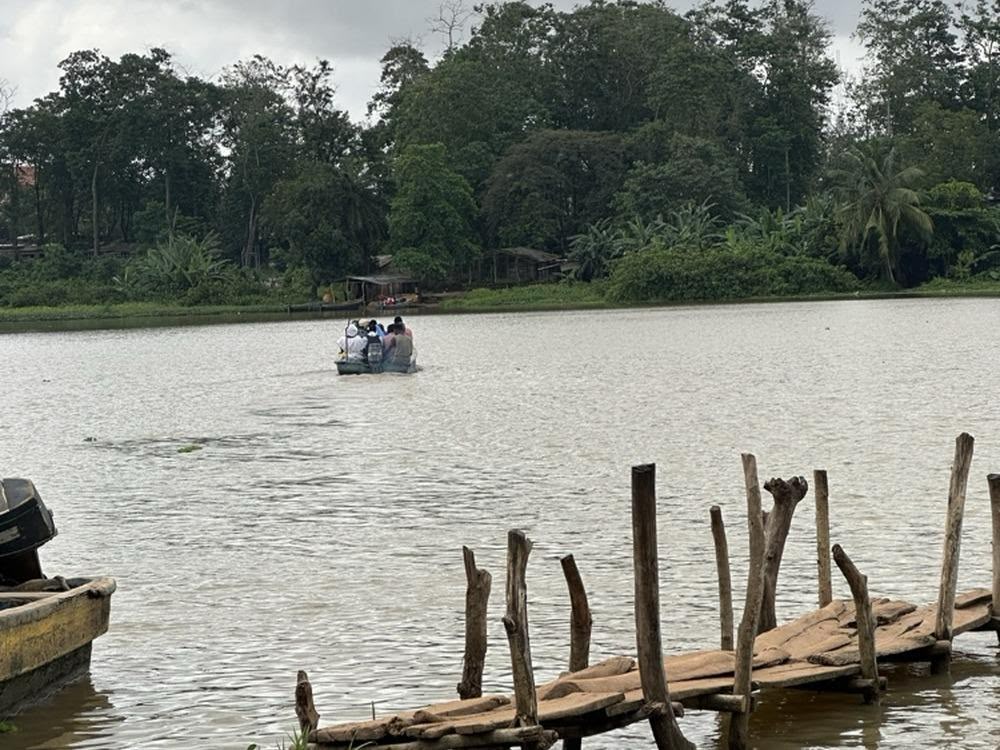
Moments later, another boat approached and eventually towed the stranded passengers to safety.
Although everyone arrived safely, the experience exposed the frightening reality behind what has become an ordinary means of transportation for hundreds of residents around Apete and its neighbouring communities in Ibadan, Oyo State.
For years, the Eleyele River crossing has provided residents with a cheaper and faster alternative to travelling by road.
At just ₦100 per trip, the boat service connects communities separated by the river, helping workers, traders, students and other commuters save money and valuable time.
But beneath the convenience and affordability lies a growing concern: how safe are the boats transporting hundreds of people across the river daily?
A daily lifeline for hundreds of commuters
By 7:30 a.m. every weekday, queues of passengers have already begun forming at the Eleyele River crossing.
Workers, traders, schoolchildren and other residents wait patiently for their turn to board boats connecting Eleyele with communities around Apete and Awotan.
For many residents, the crossing is an essential part of their daily routine.
A journey that could cost considerably more by road takes only a few minutes by water, with passengers paying just ₦100.
The service connects residents of Idunnu, Oba-Ido, Alakuta, Aderogba, Ogo Oluwa and Idi Mango, among other neighbouring communities.
While some commuters use the crossing to get to their workplaces, others depend on it to reach schools, markets, churches and other destinations across the river.
Sodiq, a commercial motorcyclist familiar with the route, estimates that between 700 and 1,000 passenger journeys are made across the river daily.
The steady movement of boats and the growing queues of commuters waiting to board underscore the importance of the service to the surrounding communities.
How a ₦100 boat ride saves residents from transport hardship
For 22-year-old Medina, who lives in Alakuta and works around Jericho, the river crossing is more than a convenient alternative. It is an important means of managing her limited income.
She earns ₦60,000 monthly. According to her, commuting to work entirely by road through Awotan, Apete and Eleyele would require at least three commercial motorcycle rides and cost approximately ₦3,000 daily.
That translates to about ₦90,000 for 30 days, an amount significantly higher than her monthly salary.
The boat service, however, offers her considerable relief.
Medina says she spends less than ₦500 on her daily return journey in most cases, although the amount sometimes rises to between ₦600 and ₦700.
From the landing point, she walks home. She also benefits from an informal arrangement among regular passengers, who sometimes pay one another’s fares and return the favour on another occasion.
For Mr Adeshina, a civil servant at the Oyo State Secretariat, the river has equally become an indispensable part of his family’s transportation arrangements.
Having used the crossing for more than four years since moving into a house less than a kilometre from the river, he describes it as a blessing that has drastically reduced his transportation expenses.
His wife, a trader, also uses the crossing daily to get to her business, while their three children depend on it to get to school.
For the family, the river is not merely a shortcut. It is a transportation lifeline that makes work, business and education more accessible.
The fare, which was previously ₦50, increased to ₦100 a few months before this report, following rising fuel prices.
Despite the increase, residents say the service remains considerably cheaper than travelling the entire distance by road.
For low-income earners, the difference is significant. It can determine whether a daily journey remains affordable or becomes another financial burden.
The collapse of Apete Bridge and the rise of water transportation
The growing dependence on the Eleyele River crossing is closely linked to the history of Apete Bridge.
On August 26, 2011, devastating rainfall triggered widespread flooding across parts of Ibadan. The Eleyele Reservoir overflowed, resulting in the loss of more than 120 lives and the destruction of properties.
Apete Bridge also collapsed during the disaster, severely disrupting transportation and movement between neighbouring communities.
In response to the flooding challenges, the Oyo State Government subsequently established the Ibadan Urban Flood Management Project (IUFMP), with funding and technical support from the World Bank, to strengthen flood-risk management and improve infrastructure.
With the bridge destroyed, residents were forced to rely on alternative and often longer road routes.
Some travelled through Fanawole, Osajin, Ajibode and the University of Ibadan axis to connect with Sango and Ojoo, while others used the Lifeforte, Adeosun and Unity Road axis to reach Ologuneru before proceeding through Eleyele to other parts of Ibadan.
Reconstructing the bridge was not immediate.
A temporary wooden crossing was initially constructed to enable pedestrians, particularly students of The Polytechnic, Ibadan, to move across. However, rainfall subsequently washed it away.
Another temporary bridge was later constructed but also suffered the same fate.
Eventually, a more durable bridge was reconstructed alongside improvements to the road linking Awotan.
However, by then, water transportation had already become an important alternative for residents living around the river.
Even after the road connection improved, many residents continued using the boats because they offered a faster and cheaper means of reaching their destinations.
For these commuters, the river remains a practical transportation option despite the availability of alternative road routes.
A tragic reminder of the dangers of water transportation
While the Eleyele River crossing offers considerable economic relief, its history is also marked by a devastating tragedy.
On February 10, 2015, five people drowned after a canoe capsized while returning from Eleyele during a windstorm and heavy rainfall.
The victims included two couples from two families and a woman visiting one of them.
Among them was Nafiu Tunde Yusuf, then chairman of the Idunnu Community Landlords’ Association, the community closest to the river crossing.
Yusuf was known for helping residents cross the river. Having learnt how to paddle, he sometimes ferried passengers when regular canoe operators had stopped working for the day.
Tragically, he became one of the victims of the ill-fated journey.
He died alongside his wife, Moriliat Alaba Yusuf. The other couple, Sulaiman Ahmed and his wife, Mulikat Ahmed, also lost their lives, while the fifth victim was Ramotalai Mudashiru, who was visiting the Yusuf family.
A report by the Nigerian Tribune quoted Martins Akinyosoye, then security committee chairman of Awotan Community, as saying that eyewitnesses attributed the incident to storm waves.
Yusuf and his wife left behind three children.
Although the 2015 tragedy involved a traditional canoe rather than the motorised passenger boats commonly used today, the incident remains a painful reminder of the dangers associated with water transportation, particularly during adverse weather conditions.
It also reinforces the need for adequate safety measures to protect passengers who depend on the river every day.
Inside the daily operations of the boat service
Currently, between 10 and 15 boat operators are involved in transporting passengers across the river.
A commercial motorcyclist, Ajetunmobi, familiar with the route, says operations become particularly busy from about 7:30 a.m. and remain active until approximately 10 a.m.
Passenger traffic increases again in the evening as workers and other commuters return home.
Boat operations sometimes continue until about 8:30 p.m.
Weekends are generally less busy because many workers and schoolchildren are not travelling to their usual destinations, although churchgoers continue to use the crossing on Sundays.
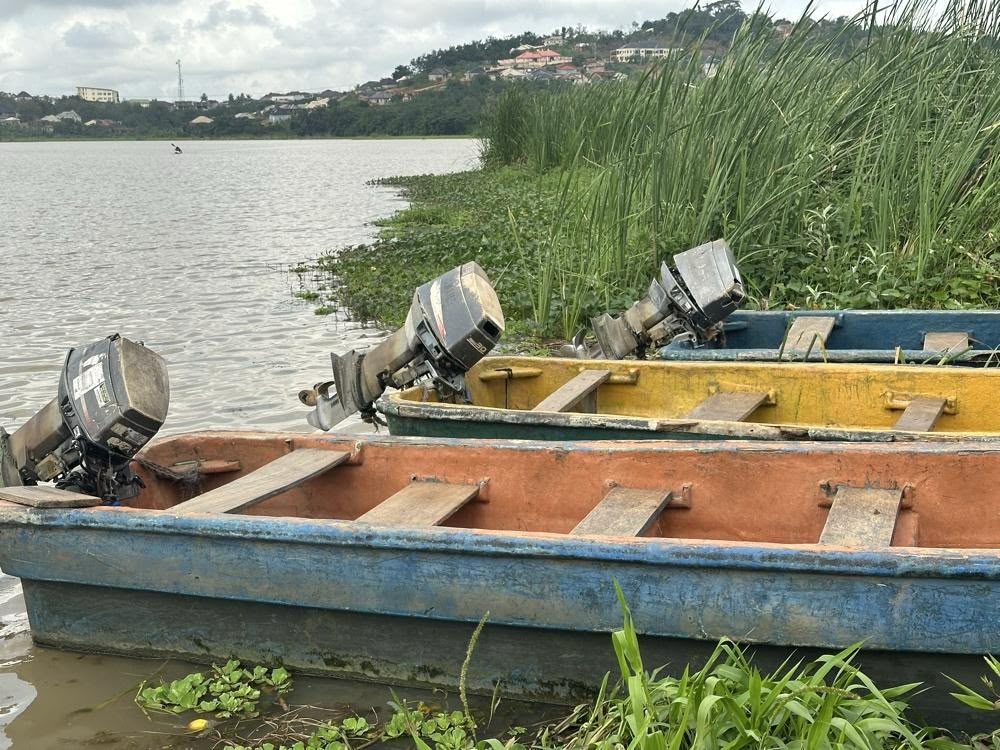
The boats are motorised and have plastic bodies, foam padding and flat wooden seats.
A commonly observed arrangement consists of five wooden planks, with approximately three passengers sitting on each plank, giving an estimated capacity of 15 passengers. However, the number varies from one boat to another.
Unlike conventional passenger boats, these vessels have no standard backrests. Passengers sit directly on the wooden planks, while some parents carry their children on their laps.
In some instances, operators ask adults travelling with more than one child to allow the children to sit together rather than carry several of them on their laps.
Passengers are also instructed to adjust their positions when necessary to distribute weight and maintain the boat’s balance.
Depending on the passenger load, water conditions, approaching boats and the speed of the engine, a crossing can take less than a minute or between two and three minutes.
During quieter periods, operators sometimes wait until they have enough passengers before embarking on a trip, while commuters in a hurry can pay for additional seats.
Safety concerns behind the affordable transportation
Despite the importance of the service, observations at the crossing raise serious questions about passenger safety.
Life jackets are available, and some operators insist that passengers wear them before boarding. However, compliance is inconsistent, with some regular commuters, including children, boarding without requesting or wearing life jackets.
The seating arrangements also raise questions about passenger capacity.
Although approximately 15 people can fit into the commonly observed arrangement, the officially approved passenger limit for the boats could not be established.
Another concern is fuel handling.
Some operators have been observed using ordinary plastic beverage bottles as fuel containers, with hoses connected to their engines.
This practice raises concerns about the safe storage and handling of fuel, particularly when passengers are on board.
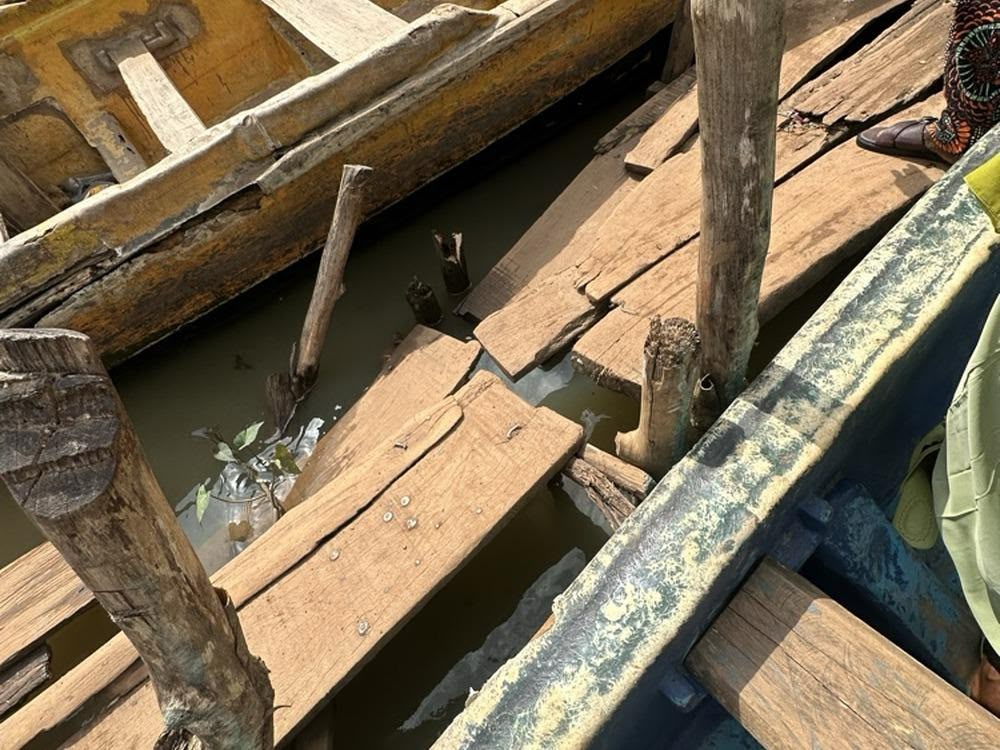
The wooden planks and structures used for boarding also require regular maintenance. Some are exposed to the elements and show signs of deterioration, while water vegetation sometimes obstructs sections of the route.
It is important to acknowledge that safety practices differ among operators. Some insist on life jackets, while others appear less strict.
However, passenger safety should not depend solely on the personal attitude or discretion of individual boat operators.
There is an urgent need for uniform safety regulations, effective monitoring and enforcement to ensure that every passenger is adequately protected.
A personal experience that highlights the risks
Having used the crossing for approximately three years, I now rely on it for about 60 per cent of my journeys to Eleyele and other destinations, including Dugbe, Oke Ado, Challenge, Ring Road, Mokola and Ologuneru.
Although I first learnt about the route many years ago, I was initially apprehensive about travelling by water.
Repeated journeys gradually made me more comfortable with the service, and I have since introduced some friends to the route. However, many have declined because of their fear of water transportation.
The experience of the boat engine failing midway through the river has nevertheless reinforced my understanding that familiarity does not eliminate danger.
This report draws on interviews with commuters and residents, direct observations at the crossing and my experience as a regular passenger.
Several boat operators declined or were unavailable for interviews. One operator initially agreed to speak but subsequently stopped responding.
Beyond cheap fares: The urgent need for safer water transportation
For residents of Idunnu, Alakuta, Aderogba, Ogo Oluwa, Idi Mango and other neighbouring communities, the Eleyele River crossing provides an important transportation service.
Its affordability helps residents reduce transportation costs, save time and access destinations that would otherwise be more expensive to reach.
However, the people who depend on this service deserve more than affordable fares. They deserve safe and reliable transportation.
Relevant government agencies and waterway authorities must work with boat operators and community representatives to establish and enforce clear passenger limits, make life-jacket use compulsory, conduct routine boat inspections, regulate fuel storage and handling, and introduce basic emergency-response arrangements.
There is also a need to provide safer and more sophisticated passenger boats, alongside regular maintenance of engines and vessels.
Boat operators should receive appropriate safety training, while the wooden boarding facilities should be assessed, upgraded and properly maintained.
Beyond water transportation, road infrastructure serving these communities also requires government attention.
In March 2024, Hon. Remi Oseni, representing Ido/Ibarapa East Federal Constituency, announced the reconstruction of the Awotan-Orioda-Alakuta Road, a project he facilitated.
However, the road, which has a drainage structure on one side, does not extend fully to Alakuta, leaving residents of Idunnu and other adjoining communities with continuing access challenges.
Government intervention is therefore necessary to extend and properly reconstruct the road towards these communities, improving connectivity and providing residents with more reliable transportation alternatives.
There is also an opportunity for responsible private investment in safer boats, improved landing facilities and maintenance services.
Such investments must improve the quality and safety of the service without making fares unaffordable for the low-income residents who depend on it.
The Idunnu Community Landlords’ Association and other community stakeholders also have an important role to play in working with authorities and boat operators to promote responsible and safer transportation practices.
A blessing that must not become a death trap
The Eleyele River has become a blessing to hundreds of households around Apete and its neighbouring communities.
For workers struggling with transportation costs, traders trying to protect their business profits and parents seeking affordable ways to get their children to school, the ₦100 boat ride represents much more than a convenient shortcut.
It is an economic lifeline.
But that lifeline must not become a death trap.
The engine failure experienced during an evening crossing, the inconsistent use of life jackets, questions surrounding passenger capacity and the painful memory of the 2015 canoe tragedy all point to the need for urgent intervention.
Government agencies, waterway authorities, boat operators and community leaders must act before another avoidable tragedy occurs.
For the hundreds of people who queue every morning and evening to cross the Eleyele River, the objective should not simply be to get across the water for ₦100.
It should be to arrive safely, return home safely and have the confidence that an affordable journey will not cost them their lives.
Kehinde Ayanboade is a journalist, researcher and academic based in Ibadan, Oyo State, Nigeria.